
Navigation

Indian History: The Complete Guide
A comprehensive guide to Ancient and Medieval Indian History. Currently covers the life of Siddhartha Gautama, the Four Noble Truths, the Tirthankaras, the teachings of Mahavira, and the global spread of Buddhist and Jain philosophy.
Indian History: Buddhism
[!NOTE]
About this Guide: Gautama Buddha, the founder of Buddhism, was born in 567/563 BC at Lumbinivana in Kapilvastu. His teachings formed a global religion that strongly influenced Indian culture, art, and philosophy. This comprehensive guide covers his life, teachings, the Buddhist Councils, and the spread of Buddhism.
1. Birth and Lineage
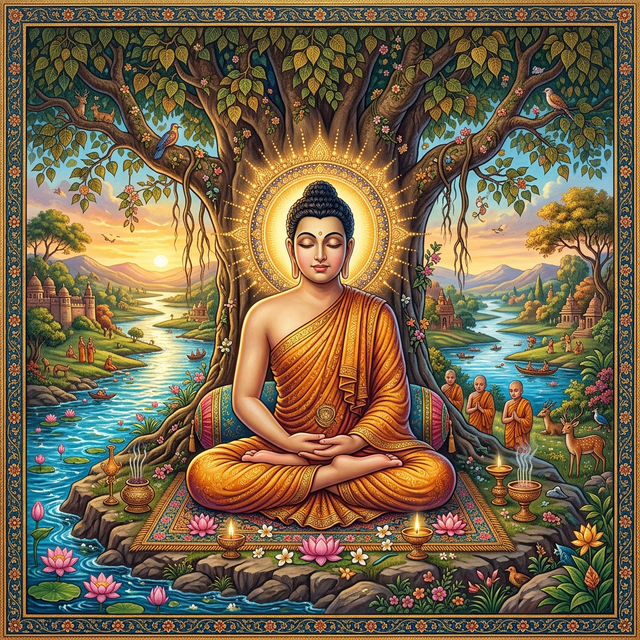
Siddhartha Gautama was born in 563 BCE in the gardens of Lumbini, which's in modern-day Nepal. He belonged to the Sakya Clan (Kshatriya Noble Family). That's why he was later called Sakyamuni, which means the sage of the Sakyas.
- Father: King Suddhodana, who ruled Kapilavastu and headed the Shakya Clan.
- Mother: Queen Mahamaya (Maya Devi), a princess of the Koshalan dynasty. Before Siddhartha was born she had a dream that a white elephant entered her side. She died seven days after he was born.
- Step-Mother: He was raised by his aunt, Mahaprajapati Gautami.
- The Prophecy: When Siddhartha was born, a sage named Asita said that he would become either a king or a great spiritual leader.
2. The Sheltered Life at Kapilavastu
King Suddhodana wanted to keep his son from becoming a leader so he shielded him from all suffering.
- Luxury: Siddhartha lived in three palaces, one for each season. He was surrounded by music, nice clothes, and got the best education.
- Family: When Siddhartha was 16 he married Yashodhara (Princess of the Koshalan dynasty). They had a son named Rahula.
- Ignorance of Reality: For 29 years Siddhartha didn't know about aging, pain and death.
3. The Turning Point: The Four Sights
Siddhartha was curious so he asked his charioteer, Channa to take him outside the palace. What he saw changed his life forever:
- 🧓 An Old Man: He saw that everyone gets old.
- 🤒 A Sick Man: He learned that the body can get sick and hurt.
- ⚰️ A Dead Body: He understood that life is temporary and will end.
- 🧘 An Ascetic: He saw a man who had no possessions, which made him think about a way to overcome suffering.
4. Mahabhinishkramana (The Great Renunciation)
Siddhartha was deeply upset by what he saw. He decided to leave his life of luxury. When he was 29 he left the palace. This event is known as Mahabhinishkramana.
- The Departure: He left the palace at night on his horse, Kanthaka with Channa.
- The Symbolic Act: He cut off his hair, traded his royal clothes for simple yellow cloth and sent Channa back to the palace.
- The Goal: He wanted to find the reason for suffering and a wandering ascetic life to end it.

5. The Search for Teachers
After he left the palace Siddhartha looked for the meditation teachers of his time to understand the mind and suffering.
- Alara Kalama: Siddhartha learned from him. Felt it was only a temporary state of mind not a permanent end to suffering.
- Uddaka Ramaputta: He then learned to reach a state of focus but Siddhartha realized it still didn't provide the ultimate answer to the cycle of rebirth.
6. The Period of Extreme Asceticism
Siddhartha thought the body was an obstacle to purity so he joined five companions in the forest of Uruvela. For six years he practiced austerities:
- Fasting: He lived on little food and became very thin.
- Breath Control: He practiced holding his breath for periods causing intense physical pain.
- The Realization: Near death he realized that a weakened body only leads to a mind. Rice milk was offered to him by Sujata, a farmer's daughter at Bodh Gaya, which broke his severe fast.
7. Enlightenment (Nirvana)
When Siddhartha was 35, he attained Nirvana (enlightenment) after 49 days of continuous meditation.

- Location: He vowed to sit under a Peepal tree in Bodh Gaya on the bank of the river Niranjana (modern name Falgu) and not rise until he found the truth.
- The Battle with Mara: As he meditated the demon Mara tried to distract him with temptations and threats. Siddhartha remained calm. Called upon the Earth to witness his merit.
- The Three Watches of the Night:
- First Watch: He saw all his lives.
- Second Watch: He saw the law of Karma and how beings are reborn based on their deeds.
- Third Watch: He understood the Four Truths and the chain of Dependent Origination.
8. The Four Noble Truths (Ariya-Sachchani)
When Siddhartha reached Enlightenment he became the Buddha. His core realization was:

- Dukkha: Life involves suffering, like birth, old age, sickness and death.
- Samudaya: Suffering is caused by craving and attachment.
- Nirodha: Suffering ends when craving and attachment end.
- Magga: The way to end suffering is the Eightfold Path.
9. The First Sermon (Dharmachakra Pravartana)
The Buddha traveled to Sarnath (Deer Park). Delivered his first sermon, known as the "Setting in Motion the Wheel of Dharma" (Dharmachakra Pravartana).
- The five companions became his disciples: Ananda and Upali were famous disciples.
- He taught the Middle Way: Avoiding the extremes of sensual indulgence and extreme self-mortification.
10. The Noble Eightfold Path (Astangika Marga)
The Buddha taught that to end suffering one must follow a Middle Way. This path is a guide to ethical and mental development, often categorized into three pillars: Wisdom, Ethical Conduct, and Mental Discipline.

- Wisdom:
- Right View (Samma ditthi): Understanding the Four Noble Truths and the nature of life.
- Right Intention (Samma sankappa): Commitment to ethical and mental self-improvement (Right Resolve).
- Ethics:
- Right Speech (Samma vaca): Speaking truth, avoiding slander.
- Right Action (Samma kammanta): Ethical conduct (not harming others).
- Right Livelihood (Samma ajiva): Earning a living without harming others.
- Mental Discipline:
- Right Effort (Samma vayama): Effort to improve and overcome wrong thoughts.
- Right Mindfulness (Samma sati): Focused awareness of reality.
- Right Concentration (Samma samadhi): Meditation to achieve a higher consciousness.
11. Establishing the Sangha (The Community)
For four decades the Buddha traveled throughout the Gangetic Plain preaching to everyone of caste or gender.
- The Triple Gem: His followers took refuge in the Buddha (Founder/Teacher), the Dhamma (Teachings), and the Sangha (Order of monks/nuns).
- The Monastic Order: He established a code of discipline for monks and nuns.
- Famous Converts: He converted kings and the feared bandit Angulimala.
- Ordination of Women: He allowed women to join the Sangha.
[!TIP]
Eight Great Places Associated with Buddhism:
Lumbini, Sarnath, Sravasti, Rajgriha, Bodh Gaya, Kushinagar, Sankisa, and Vaishali. (Patliputra is not associated directly with Buddha's life).
12. Mahaparinirvana (The Final Passing)
When the Buddha was 80, he passed away in 483 BC at Kushinagar. This event is known as Mahaparinirvana.
- The Final Meal: He became ill after eating a meal offered by a blacksmith.
- The Final Instructions: He told his disciples to strive for their liberation with diligence.
- The Posture: He passed away lying on his side between two Shala trees.
13. The Buddhist Councils
After his death, disciples organized councils to preserve and codify his teachings:
- First Council (483 B.C.): Held at Rajgriha under King Ajatshatru. Presided by Monk Mahakasyapa. Result: Compilation of the Sutta Pitaka and Vinaya Pitaka.
- Second Council (383 B.C.): Held at Vaishali under King Kalashoka, presided by Sabakami. Result: Split took place on rules into Mahasanghika and Therivadi (Sthavirvadin).
- Third Council: Held at Patliputra under Emperor Ashoka. Presided by Mogliputta Tisa. Result: “Katthavattu” was added to the Abhidhamma Patika.
- Fourth Council: Held at Kundalgrama (Kashmir) under King Kanishka. Presided by Vasumitra and Ashvagosha. Result: The formal split of Buddhism into Hinayana and Mahayana. Mahavibhasha was written in Sanskrit.
14. The Major Sects of Buddhism
As the centuries passed interpretations of the Buddha’s teachings led to the formation of main "vehicles" or schools:
- Hinayana (Lesser Vehicle): Focuses on enlightenment and strict adherence to original Pali scriptures. Buddha is seen as a great teacher, not a god.
- Mahayana (Great Vehicle): Emphasizes the role of Bodhisattvas and universal salvation. Idol worship and devotion are prominent (texts in Sanskrit).
- Vajrayana (Diamond Vehicle): Uses esoteric rituals, mantras and tantric practices to achieve enlightenment swiftly (prominent in Tibet).
- Theravada (Teaching of the Elders): The oldest form, strictly following discipline and meditation in Pali.
- Zen (Chan): Focuses on meditation (zazen) as the primary method for realizing one's inherent Buddha nature.
15. The Buddhist Scriptures

The teachings were eventually written down. They are known as the Tripitaka (in Pali) or Three Baskets:
- Sutta Pitaka: The sermons and dialogues of the Buddha (divided into five Nikayas).
- Vinaya Pitaka: The rules and discipline (Patimokkha) for the monastic community.
- Abhidhamma Pitaka: Philosophical and psychological analysis of the teachings.
Non-canonical Texts:
- Mahavastu (Sacred biography)
- Nidanakatha (First connected life story)
- Milindapanho (Dialogue between Greek King Menander and Monk Nagasena)
- Visuddhimagga (Path to purification by Buddhaghosa)
16. The Spread of Buddhism & Ashoka's Role
Buddhism might have remained an Indian sect if not for Emperor Ashoka of the Mauryan Empire (Greatest patron).

- The Kalinga War: After a bloodbath, Ashoka felt deep remorse and converted to Buddhism.
- Dhamma Propagandists: He sent missions, including his son Mahendra and daughter Sanghamitra to Sri Lanka, spreading Buddhism into West Asia and making it a world religion.
- Pillars: He inscribed the Buddha’s teachings on rocks and stone pillars.
- Last Patrons: The Palas of Bengal & Bihar were the last great patrons of Buddhism in India.
17. Why Buddhism Spread Rapidly
Buddhism offered revolutionary ideas that appealed to the masses in ancient India:
- Rejection of Caste: It taught that spiritual worth is based on actions, not birth.
- Local Language: The Buddha preached in Pali, the language of the people.
- Social Equality: It welcomed women and the lower classes into the fold.
Contribution of Buddhism to Indian Culture
- Ahimsa (Non-Violence): Encouraged peace and kindness in society.
- Art and Architecture: Inspired beautiful stupas at Sanchi, Bharhut, and Gaya.
- Education: Set up great learning centers like Taxila, Nalanda, and Vikramasila.
Buddhism – Reasons for Decline
From the 12th century, Buddhism began to disappear from India due to:
- Corruption in Sangha: Wealth and gifts led to luxury, ignoring core principles.
- Division: Splintering into numerous complex sects (Tantrayana, etc.) lost its original simplicity.
- Use of Sanskrit: Adopting Sanskrit alienated the common masses.
- Buddha Worship: Image worship made it seem like it was folding back into complex Hinduism.
- Persecution & Invasions: Targeted by certain Brahmana rulers and heavily devastated by later Muslim invasions which destroyed rich monasteries.
Final Overview: The Life of Buddha at a Glance
[!TIP]
Reflection: Buddha said he was not a god. He called himself a doctor. He found a cure, for suffering, which he saw as a sickness.
Practice MCQs – Buddhism
[!TIP]
Test your knowledge about the life of Gautama Buddha, the Noble Truths, and the spread of Buddhism with our interactive practice MCQs. Click the button below to start the specific quiz for this module.