
Navigation
Indian History: Jainism
[!NOTE]
About this Guide: Jainism is an ancient Indian religion that teaches a path to spiritual purity and enlightenment through disciplined non-violence (ahimsa) to all living creatures. This guide covers the Tirthankaras, the life of Mahavira, Jain philosophy, and the spread and sects of Jainism.
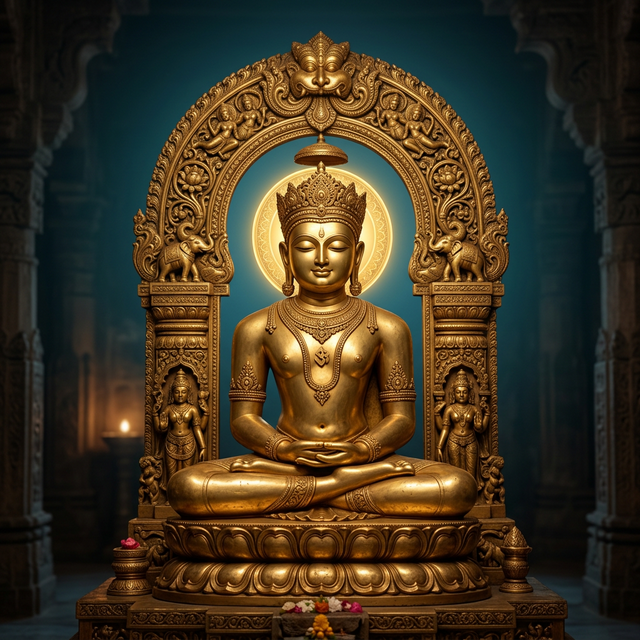
1. The Concept of the Tirthankara
In Jainism a Tirthankara is a special being who has overcome the cycle of death and rebirth and shown a path for others to follow.
- The Number 24: Jain tradition says that in every cycle of time 24 Tirthankaras are born to teach the eternal Dharma.
- Nature: They are not gods. They are "Enlightened Teachers" who have achieved Infinite Knowledge.
- Identification: Each Tirthankara has a symbol, color, and tree to help people identify them in pictures.
2. Rishabhanatha, The First Tirthankara
Rishabhanatha is also known as Adinatha. He is credited with starting the current spiritual lineage and laying the foundations of human civilization.
- Life: He is believed to have lived millions of years in Ayodhya.
- Contributions: Before becoming an ascetic he taught humans the six professions: warfare, writing, agriculture, arts, trade and crafts.
- Renunciation: He renounced his kingdom to seek truth, and his son, Bharata, became a universal ruler.
- Symbol: The Bull is his symbol.
- Historical Note: Historians find it interesting that the name Rishabha appears in the Rigveda and the Vishnu Purana, which they think is evidence of the antiquity of the tradition in Indian thought.
3. The 23rd Tirthankara: Parshvanatha
Parshvanatha is recognized by historians as a figure who lived around 250 years before Mahavira.
- Birth: He was born as a prince in Varanasi to King Ashvasena and Queen Vama.
- Enlightenment: At the age of 30 he left the life to become an ascetic and after 84 days of intense meditation he achieved Enlightenment.
- Teachings: He taught four core principles: Non-violence, Truthfulness, Non-stealing and Non-possession.
- Symbol: The Serpent is his symbol.
- Connection to Mahavira: Many of Mahaviras parents and early followers were reportedly followers of the tradition established by Parshvanatha.
4. The Pre-Mahavira Ascetic Tradition
It is a mistake to think that Mahavira "founded" Jainism but he was actually a reformer who built upon a pre-existing tradition.
- The Shramana Movement: This was a non-Vedic movement of wandering ascetics who sought truth through meditation and austerity.
- Core Tenets: The core tenets of Jainism, such as Non-violence and the multifaceted nature of reality, were already part of the landscape of ancient India.
- Archaeological Evidence: Archaeological evidence like the naked ascetic figures found in the Indus Valley Civilization are cited by scholars as early precursors to Jain yogic practices.
5. List of Key Tirthankaras for Competitive Exams

There are 24 Tirthankaras. These are the ones most frequently asked about in exams:
| Number | Name | Significance | Symbol |
|---|---|---|---|
| 1st | Rishabhanatha | The founder and first teacher. | Bull |
| 2nd | Ajitanatha | Second in the lineage. | Elephant |
| 19th | Mallinatha | Shvetambara sect believes Mallinatha was female. | Water Pot |
| 21st | Naminatha | Known for his detachment. | Blue Lotus |
| 22nd | Arishtanemi | Believed to be a cousin of Lord Krishna. | Conch Shell |
| 23rd | Parshvanatha | Immediate predecessor of Mahavira. | Serpent |
| 24th | Mahavira | The Tirthankara of this era. | Lion |
6. Birth and Early Life of Mahavira

Mahavira was born into a royal family in ancient India.
- Birthplace: He was born in Kundagrama, near Vaishali in modern-day Bihar.
- Lineage: He belonged to the Jnatrika Clan of the Kshatriya varna.
- Parents: His father was King Siddhartha and his mother was Queen Trishala.
- Birth Name: He was given the name Vardhamana (meaning "prosperous"), because his father's kingdom flourished after his conception.
7. The Great Renunciation
Mahavira felt a spiritual calling, but he waited until his parents passed away before seeking permission to leave the palace.
- Departure: At the age of 30 he abandoned all possessions and became a wandering monk.
- Ascetic Life: For 12 years he practiced meditation and rigorous self-denial, enduring physical hardships and severe weather.
8. Attainment of Kevala Jnana
At the age of 42, Mahavira achieved the ultimate spiritual goal in Jainism: Kevala Jnana (Infinite Knowledge).
- The Conqueror: He became a Jina, a Conqueror who has conquered his enemies (desires and attachments).
- Titles: He was known as the Omniscient one, freed from all bonds, and the one who builds a bridge across the ocean of suffering.
9. The Five Great Vows (Pancha Mahavrata)

Mahavira adopted the four vows established by Parshvanatha and added a fifth vow, Celibacy.
- Ahimsa: Non-violence
- Satya: Truth
- Asteya: Non-stealing
- Aparigraha: Non-possession
- Brahmacharya: Celibacy
10. The Philosophy of Anekantavada
Mahavira taught that truth and reality are complex and have multiple aspects.
- Relativity of Truth: No single human point of view can claim to have the absolute truth.
- The Parable: He used the parable of the Blind Men and the Elephant to explain this concept—each blind man touched a different part and therefore had a partial view of reality.
11. Mahaparinirvana
After preaching for 30 years Mahavira passed away at the age of 72.
- Liberation: He attained liberation (Moksha) from the cycle of birth and death at Pavapuri.
- Festival: Jains celebrate Diwali as the "Festival of Lights" to commemorate his knowledge and enlightenment.
12. Comparison: Parshvanatha vs. Mahavira
| Feature | Parshvanatha | Mahavira |
|---|---|---|
| Vows Taught | Chaturyama Dharma (four vows) | Pancha Mahavrata (five vows, added Celibacy) |
| Ascetic Practice | Allowed his followers to wear a garment | Practiced and preached strict, total nudity (for monks) |
13. Spread of Jainism
After Mahavira's death, Jainism initially remained concentrated in the Magadha region. However, several historical factors led to its migration across the subcontinent.
- The Southern Migration: A large group of Jain monks migrated to Karnataka to escape a severe 12-year famine in Magadha.
- Expansion to Central & Western India: Jainism moved westward, and Gujarat became a major stronghold.
- Kalinga (Odisha): Jainism found a massive patron in Emperor Kharavela, who recorded his devotion in the Hathigumpha Inscription.
14. Royal Patronage and Support
Jainism's survival and growth were heavily aided by the support of powerful ruling dynasties.
- Chandragupta Maurya: He became a follower of Bhadrabahu in his later years. He is said to have given up his throne and traveled to Shravanabelagola in Karnataka, where he practiced Sallekhana (fasting until death).
- Samprati (Mauryan): The grandson of Ashoka, Samprati is often called the "Jain Ashoka" because he built thousands of Jain temples and extensively spread the faith.
- South Indian Patrons: The Gangas and Kadambas supported the construction of the Gommateshwara statue at Shravanabelagola, the world's tallest free-standing monolithic statue. King Amoghavarsha of the Rashtrakutas even wrote a Jain philosophical work in Kannada.
- The Solankis (Gujarat): Under King Kumarapala, Jainism almost became the state religion of Gujarat in the 12th century.
15. The Sectarian Split (Digambara & Shvetambara)

The formal division in Jainism began about 200 years after the death of Mahavira due to a severe 12-year famine in the Magadha region.
- The senior monk Bhadrabahu led a group of 12,000 monks to Shravanabelagola in South India to maintain monastic vows during the famine.
- Another group stayed behind in Magadha under the leadership of Sthulabhadra. To survive the famine and maintain some level of order they began wearing white cloth.
- The Rift: When the famine ended and the southern monks returned, they were shocked to see their counterparts wearing clothes and following a compiled scripture they did not recognize. This led to a permanent rift.
A. The Digambara Sect
- Core Belief: Believes that to achieve liberation one must be completely detached from all possessions, including clothes. Therefore, monks remain completely naked.
- Possessions: They carry a Picchi (feather broom) and a Kamandalu (gourd).
- Women's Liberation: Holds the strict view that a woman cannot attain Moksha in a female body; she must be reborn as a man.
B. The Shvetambara Sect
- Core Belief: Follows a moderate path of asceticism where monks and nuns wear simple white garments.
- Practices: They use a Muhapatti (cloth over the mouth) to prevent the inhalation of small organisms.
- Women's Liberation: Believes that women are equally capable of attaining Moksha (and that the 19th Tirthankara, Mallinatha, was a female).
16. The Triratna (Three Jewels) of Jainism

To attain liberation (Moksha) and stop the influx of karma, Mahavira prescribed the Triratna or Three Jewels. They must be practiced together:
- Samyak Darshana (Right Faith/Belief): Unwavering belief in the teachings of the Tirthankaras.
- Samyak Jnana (Right Knowledge): Understanding the true nature of the universe (Jiva and Ajiva) without any doubt.
- Samyak Charitra (Right Conduct): Living life strictly according to the ethical principles (the Five Vows) to avoid bad karma and eliminate existing karma.
17. Syadvada (The Theory of Maybe)

Closely related to Anekantavada (the multifaceted nature of reality) is Syadvada, the Jain theory of relativity of knowledge.
- The Concept: It asserts that all judgments or statements are conditional, and hold good only in certain conditions, circumstances, or senses.
- The Prefix: Jains use the word Syat (meaning "perhaps" or "from a certain perspective") before asserting a statement to indicate that it is only a partial truth.
- Significance: This philosophical stance promotes profound intellectual tolerance and non-violence in thought and speech.
18. Jain Architecture and Art

Jainism contributed significantly to India's architectural heritage, favoring intricate carvings, massive statues, and high-altitude mountain temples.
- Gumphas (Caves):
- Udayagiri and Khandagiri Caves (Odisha): Carved during King Kharavela's reign. Features the famous Hathigumpha inscription.
- Ellora Caves (Maharashtra): Indra Sabha and Jagannath Sabha.
- Massive Statues (Bahubali/Gommateshwara):
- The 57-foot tall monolithic statue of Lord Bahubali (son of Rishabhanatha) at Shravanabelagola, Karnataka. The Mahamastakabhisheka festival is held here every 12 years.
- Temples (Jinalayas):
- Dilwara Temples (Mount Abu, Rajasthan): World-famous for their staggering, intricate white marble carvings.
- Ranakpur Temples (Rajasthan): Known for the massive Adinatha temple supported by 1,444 uniquely carved marble pillars.
- Palitana Temples (Shatrunjaya Hills, Gujarat): A massive complex of over 800 temples on a single mountain.
19. The Decline of Jainism
Unlike Buddhism, which spread across Asia but nearly vanished from India, Jainism never became a global religion but survived continuously in India (especially amongst upper-caste merchants). Why did it decline from its peak?
- Extreme Austerity: The rigorous asceticism, extreme fasting, and strict Ahimsa were too difficult for the average peasant or warrior to follow.
- Lack of Royal Patronage: Over time, powerful kings shifted their patronage back to reviving Brahmanical Hinduism or to Buddhism.
- Assimilation: Jainism did not violently oppose the Varna system like Buddhism did. It adapted and co-existed closely with Hinduism, blurring the lines of distinction for the common people over centuries.
20. Essential Jain Glossary for Exams
- Jiva and Ajiva: The universe is divided into the conscious/living soul (Jiva) and the unconscious/non-living matter (Ajiva).
- Kaivalya: The ultimate state of absolute knowledge and liberation from the cycle of birth and death.
- Sallekhana (or Santhara): The religious practice of voluntarily fasting to death when one feels their life has served its purpose, meant to purge final karmas.
- Basadis (or Viharas): Jain monastic establishments or temples.
- Tirthankara: Literally "Ford-maker"—one who creates a bridge across the ocean of worldly suffering (Samsara).
21. The Councils & Literature
Jainism used the language of the people, not the Sanskrit of the Brahmins, which helped greatly in its early spread.
- Ardhamagadhi: The original teachings were delivered in Ardhamagadhi, a form of Prakrit, and the Agamas (Jain texts) were written in this language.
- First Council: Held in Pataliputra in the 3rd Century BCE and led by Sthulabhadra. They compiled the 12 Angas (which the Digambaras reject).
- Second Council: Held in Vallabhi in the 5th/6th Century CE, led by Devardhi Kshamasramana. This council finally put the Shvetambara canon into written form as we know it today.
- Sanskrit Phase: Later, Jain scholars like Umaswati (Tattvartha Sutra) and Hemachandra began writing in Sanskrit to engage with other philosophical schools on an intellectual level.
22. Practice MCQs – Jainism
[!TIP]
Test your knowledge about the life of Mahavira, the Tirthankaras, Jain philosophy, and more with our interactive practice MCQs. Click the button below to start the quiz for this section.